





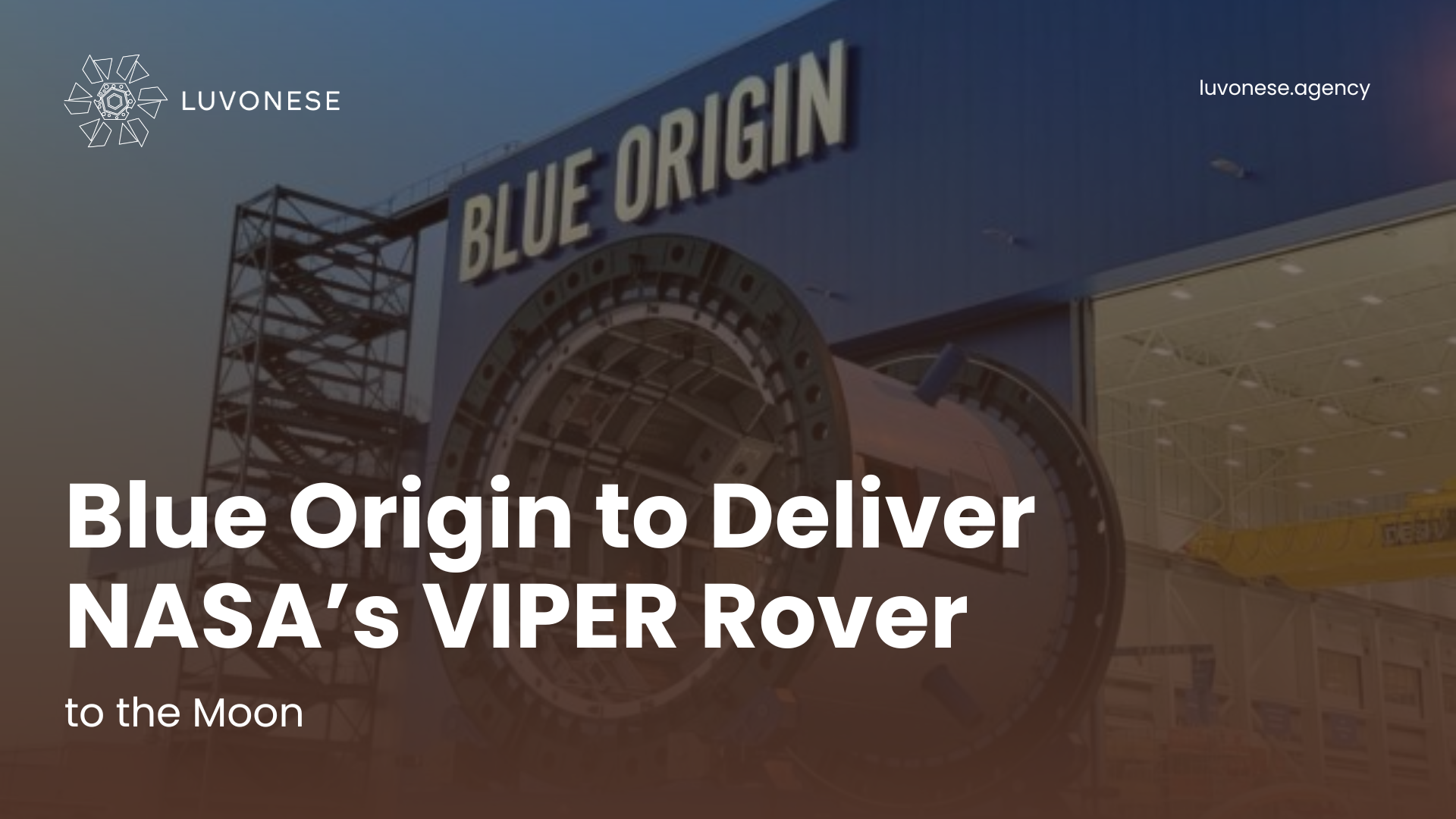
The race to explore the Moon has taken another step forward. NASA has awarded Jeff Bezos’ aerospace company, Blue Origin, a $190 million task order to develop a delivery plan for the Volatiles Investigating Polar Exploration Rover (VIPER). If successful, this plan could place the rover on the Moon’s south pole in the near future.
The award was issued under NASA’s Commercial Lunar Payload Services (CLPS) program, which contracts private space companies to provide delivery services to the lunar surface. However, the award does not guarantee deployment. Before Blue Origin can carry the valuable rover, the company must demonstrate that its Blue Moon MK1 lander is capable of successfully landing on the Moon by the end of 2025 with a NASA technology payload onboard.
Blue Moon MK1 and Mission Requirements
Blue Origin first won a lunar cargo contract in 2023 and has since designed the Blue Moon MK1 lander to meet NASA’s requirements. Its initial demonstration flight will carry NASA stereo cameras for surface mapping and small spheres with laser technology for mission tracking. Only after proving the MK1’s performance will NASA decide whether Blue Origin can deliver VIPER itself.
A Statement from NASA and Blue Origin
“The contract includes an option to deliver and safely deploy VIPER on the Moon. NASA will make this decision after reviewing the base task and evaluating Blue Origin’s first Blue Moon MK1 mission,” the agency said in a statement.
On the same day, Blue Origin announced on X (formerly Twitter): “Our second Blue Moon MK1 lander is already in production and well-suited to support the VIPER rover. This mission is vital for future lunar permanence and will help reveal the origin and distribution of water on the Moon.”
About the VIPER Rover
VIPER—short for Volatiles Investigating Polar Exploration Rover—was designed to explore the lunar south pole and search for ice and other resources. Standing 2.5 meters tall and weighing almost 500 kilograms, the rover is equipped with a one-meter drill and three scientific instruments. Originally scheduled for launch in 2023, the project faced delays and rising costs. By July 2024, NASA had cancelled the mission, but the CLPS award to Blue Origin now appears to have revived it.
The Role of Private Space Companies
The growing participation of private aerospace firms has transformed lunar exploration. Companies like Blue Origin, Firefly Aerospace, and SpaceX are now working under NASA’s CLPS contracts, offering the potential to reduce traditional mission costs and allowing NASA scientists to focus on scientific objectives.
NASA’s Broader Lunar Strategy
“NASA is leading the world in exploring more of the Moon than ever before,” said acting NASA Administrator Sean Duffy. “VIPER will explore the challenging environment of the lunar south pole, investigating permanently shadowed regions to guide future astronaut landing sites and expand our understanding of the Moon’s environment. These insights are essential for sustaining humans on longer missions as America leads the next chapter in space exploration.”