






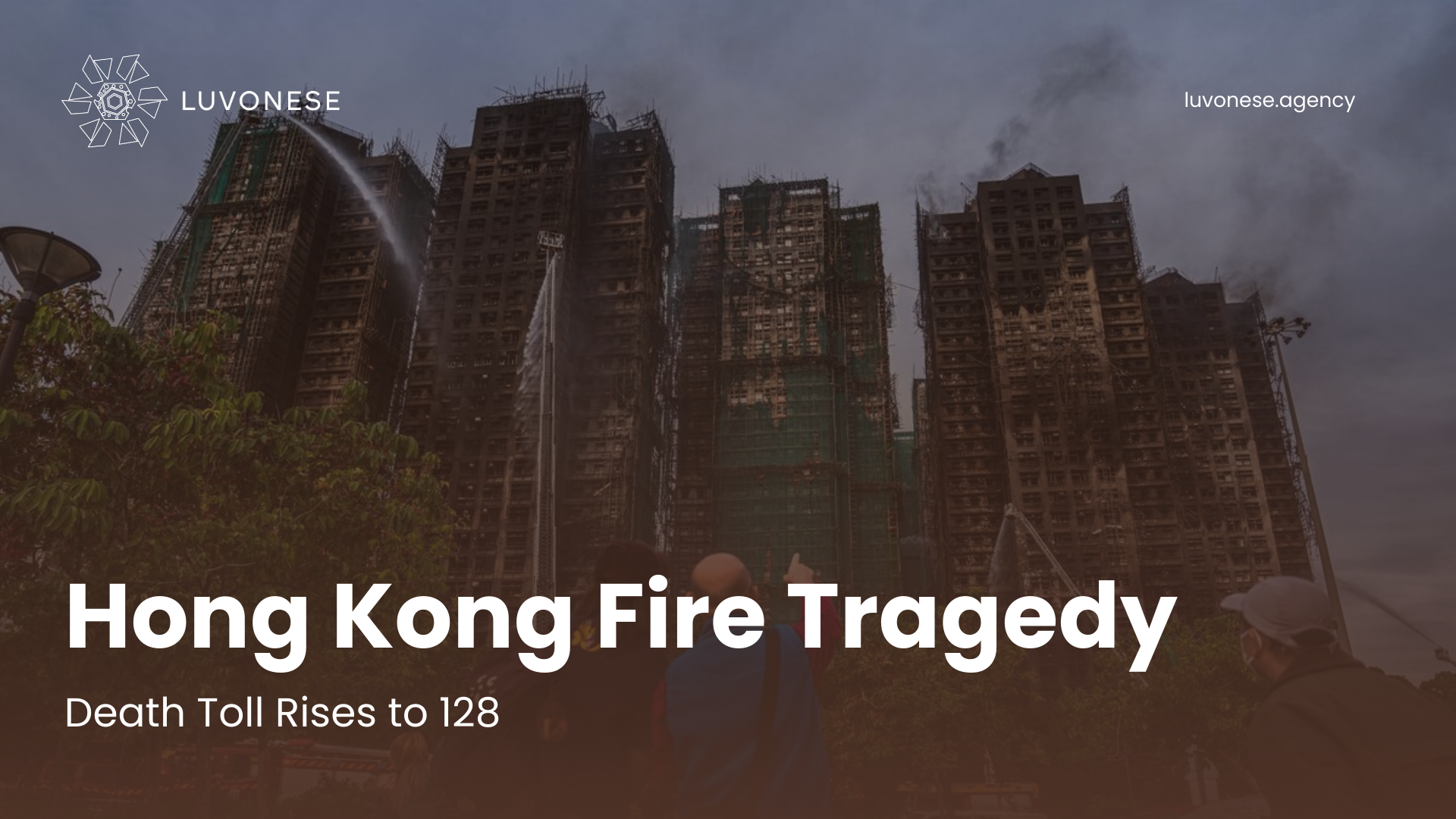
A National Shock: Hong Kong’s Deadliest Blaze Since 1948
The Hong Kong fire at the Wang Fuk Court residential estate has become the city’s worst blaze in nearly 80 years. Authorities confirmed that 128 people have died, while roughly 200 others remain missing, fueling fears of an even higher final toll. The high-rise complex in Tai Po, home to more than 4,600 residents, turned into a disaster zone within minutes as flames rapidly engulfed multiple towers.
Officials say the scale of destruction is unparalleled in modern Hong Kong, a city known for its dense urban living and stringent safety rules. The incident has triggered grief, anger, and renewed scrutiny over building regulations and oversight.
How the Blaze Spread Through the Residential Towers
The fire ignited on Wednesday afternoon and tore through eight 32-storey towers covered in bamboo scaffolding and green mesh for renovation work. These materials, traditionally used in Hong Kong construction, became an unintended accelerant as flames traveled swiftly upward.
Firefighters described intense heat, thick black smoke, and falling debris that made navigation nearly impossible. Many residents were trapped in corridors and stairwells, unable to escape due to smoke-filled exits.
Authorities found that fire alarms in parts of the complex had malfunctioned, delaying residents’ awareness of the emergency. The late detection likely contributed to the high casualty count.
Rescue Efforts End Amid Stability Risks
By Friday, emergency crews announced the end of active rescue operations due to structural dangers. Some parts of the towers remained unstable, with lingering hotspots making further entry too risky.
At least 79 people were injured, including 12 firefighters who suffered burns, smoke inhalation, and exhaustion during the 48-hour operation. Officials stated the next phase focuses on cooling the building, searching for remains, and initiating a comprehensive forensic investigation.
“We cannot rule out discovering more bodies,” Hong Kong Security Chief Chris Tang said, noting that only a fraction of the deceased have been identifiable.
Renovation Negligence Under Scrutiny
Authorities confirmed the arrest of three construction company executives linked to ongoing renovation works. Police alleged “gross negligence,” citing evidence that flammable foam boards were installed near windows, obstructing ventilation and creating a fire pathway.
Documents, computers, and company records were seized during a police raid, as investigators examine bidding procedures, material sourcing, and compliance with safety codes.
The case has sparked comparisons to London’s 2017 Grenfell Tower fire, where unsafe cladding contributed to the rapid spread of flames.
Families Confront Heartbreaking Identification Process
Outside the disaster site, families waited in long lines to review photographs of the deceased taken by rescuers. Many residents reported missing spouses, children, and elderly relatives, with some arriving at shelters in shock.
One resident, Mirra Wong, said she recognized images of remains that might belong to her father. “We just need confirmation. We need closure,” she said, struggling to speak.
Dozens of foreign domestic workers—mostly from the Philippines and Indonesia—were inside the buildings when the fire struck. Migrant organizations say at least 19 remain missing, raising concerns for one of Hong Kong’s most vulnerable communities.
Temporary Shelters Overwhelmed as Residents Fear Returning Home
With the complex unsafe for re-entry, hundreds of evacuees sought refuge in nearby malls and community centers. Dozens slept on makeshift mattresses, wrapped in blankets as volunteers provided food, toiletries, and medical assistance.
“We don’t know when it will be safe to go home,” said one elderly resident, who chose to sleep in the mall’s hallway rather than an official shelter out of concern for others “who need it more.”
Chief Executive John Lee announced a HK$300 million (US$39 million) relief fund for affected families. Several major mainland Chinese companies have also pledged donations.
A High-Risk City Facing New Questions on Safety
Hong Kong’s skyline is dominated by high-rise buildings, many wrapped in bamboo scaffolding during renovation cycles. The fire has reignited debates about outdated safety standards, the continued reliance on flammable scaffolding materials, and the balance between tradition and safety.
Authorities are now considering accelerating the shift toward metal scaffolding, a move previously debated for years but resisted due to cost and cultural heritage considerations.
A Tragedy That Could Reshape Hong Kong’s Safety Policies
As investigations deepen, the Hong Kong fire is poised to become a turning point for public safety regulations. Lawmakers, construction associations, and resident groups are calling for stricter oversight, better materials, and mandatory fire-risk assessments during renovation.
With nearly 200 people still missing, families and the broader community continue to grapple with grief and uncertainty.