




Economic Breakthrough: South Korea and the US Seal Historic Trade Pact
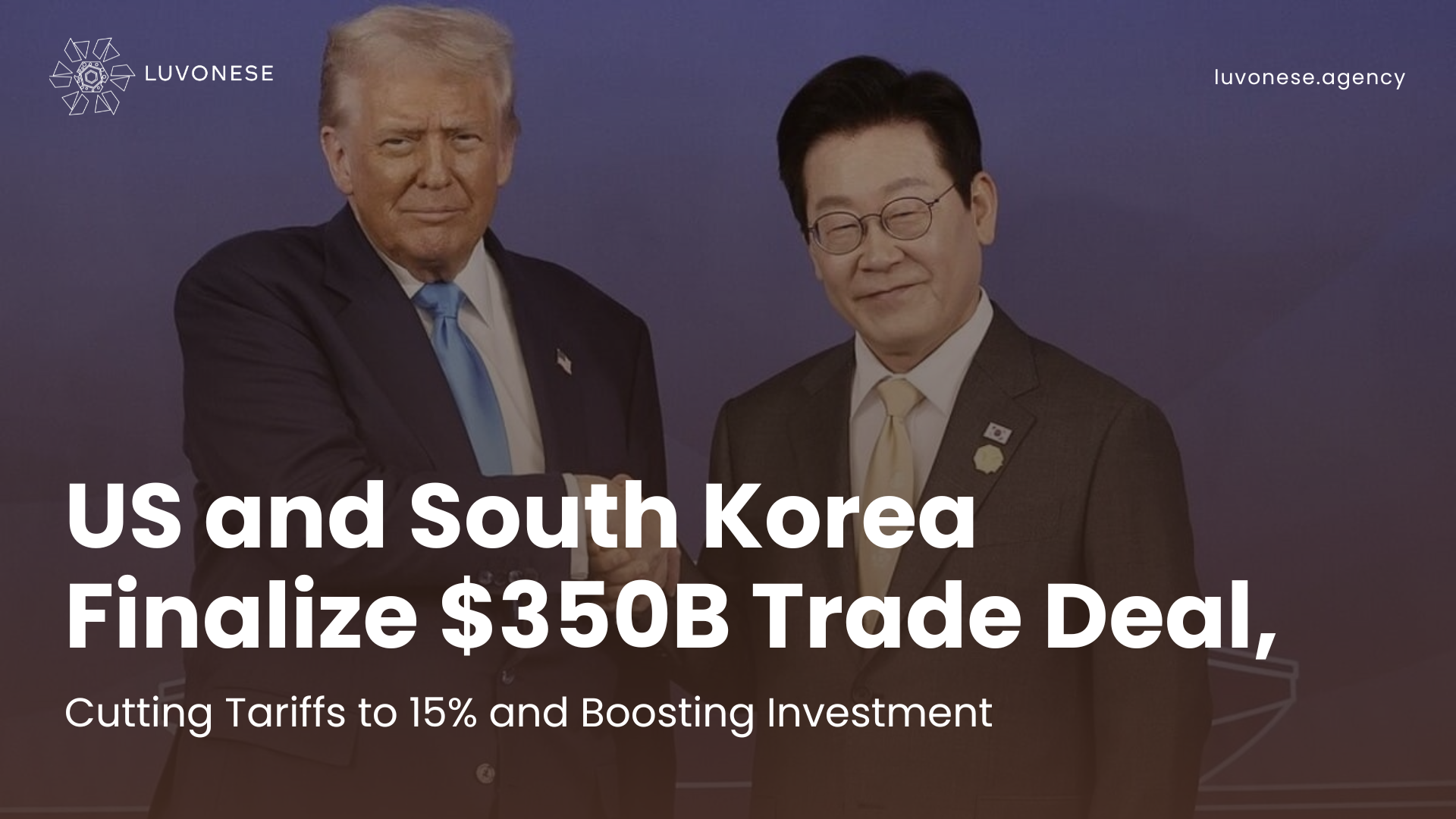
In a move signaling a new chapter in global trade, South Korea and the United States have finalized a sweeping US–South Korea trade deal worth $350 billion. Announced after a high-level meeting in Gyeongju, the agreement reduces tariffs from 25% to 15%, a move designed to stabilize both nations’ manufacturing and technology sectors.
The accord was confirmed after two hours of talks between President Donald Trump and President Lee Jae Myung, with both leaders calling it a “strategic win” for economic security in the Asia-Pacific region.
What the New US–South Korea Trade Deal Includes
- Tariff reduction: Mutual tariff cuts from 25% to 15% on automotive, steel, and tech goods.
- Investment package: South Korea will inject $350 billion into the US economy — $200 billion in cash and $150 billion in shipbuilding and infrastructure.
- Energy partnership: Seoul agreed to purchase $100 billion worth of liquefied natural gas (LNG) from the US.
Leaders Emphasize “Economic Security as National Security”
President Trump hailed the deal as “pretty much finalized,” emphasizing that it strengthens America’s industrial base and aligns with his administration’s economic policy. “We had a tremendous meeting with South Korea,” Trump said. “Economic security is national security.”
President Lee echoed that sentiment, describing the partnership as a “balance of power in trade,” ensuring both nations remain competitive against China’s growing economic influence.
Market Reactions and Industrial Impact
The announcement sparked a surge in Seoul’s stock market, with automakers and semiconductor firms leading the rally. Analysts believe the new tariff structure could help Samsung Electronics and Hyundai Motors regain momentum after months of trade uncertainty.
In the US, the deal is expected to bolster industrial output and create thousands of jobs linked to energy and shipbuilding contracts funded by Korean investment.
Diplomatic Symbolism: Golden Crown and the Grand Order of Mugunghwa
Before the meeting, Trump received South Korea’s highest civilian honor — the Grand Order of Mugunghwa — and a golden crown, a symbolic gesture celebrating the strengthened alliance between Washington and Seoul. “I’d like to wear it right now,” Trump joked during the ceremony.
Challenges and the Road Ahead
Despite optimism, experts warn that implementation will require transparency and consistent policy execution. Both nations face domestic scrutiny — from US unions demanding fair competition, to Korean lawmakers urging greater oversight on outbound investments.
Regional Context: A Broader Asian Trade Strategy
The deal follows Trump’s earlier stops in Japan and Malaysia, where he brokered new agreements on rare earth minerals and regional peace initiatives. His next destination is Busan, where he will meet China’s President Xi Jinping during the APEC Summit 2025.
Conclusion: A Turning Point in Trans-Pacific Relations
The US–South Korea trade deal underscores both nations’ resolve to maintain economic independence amid global uncertainty. With reduced tariffs, a $350 billion investment pledge, and revived diplomatic momentum, this agreement could redefine the future of trans-Pacific trade and global manufacturing power balance.