





Venezuela Military Alert Intensifies
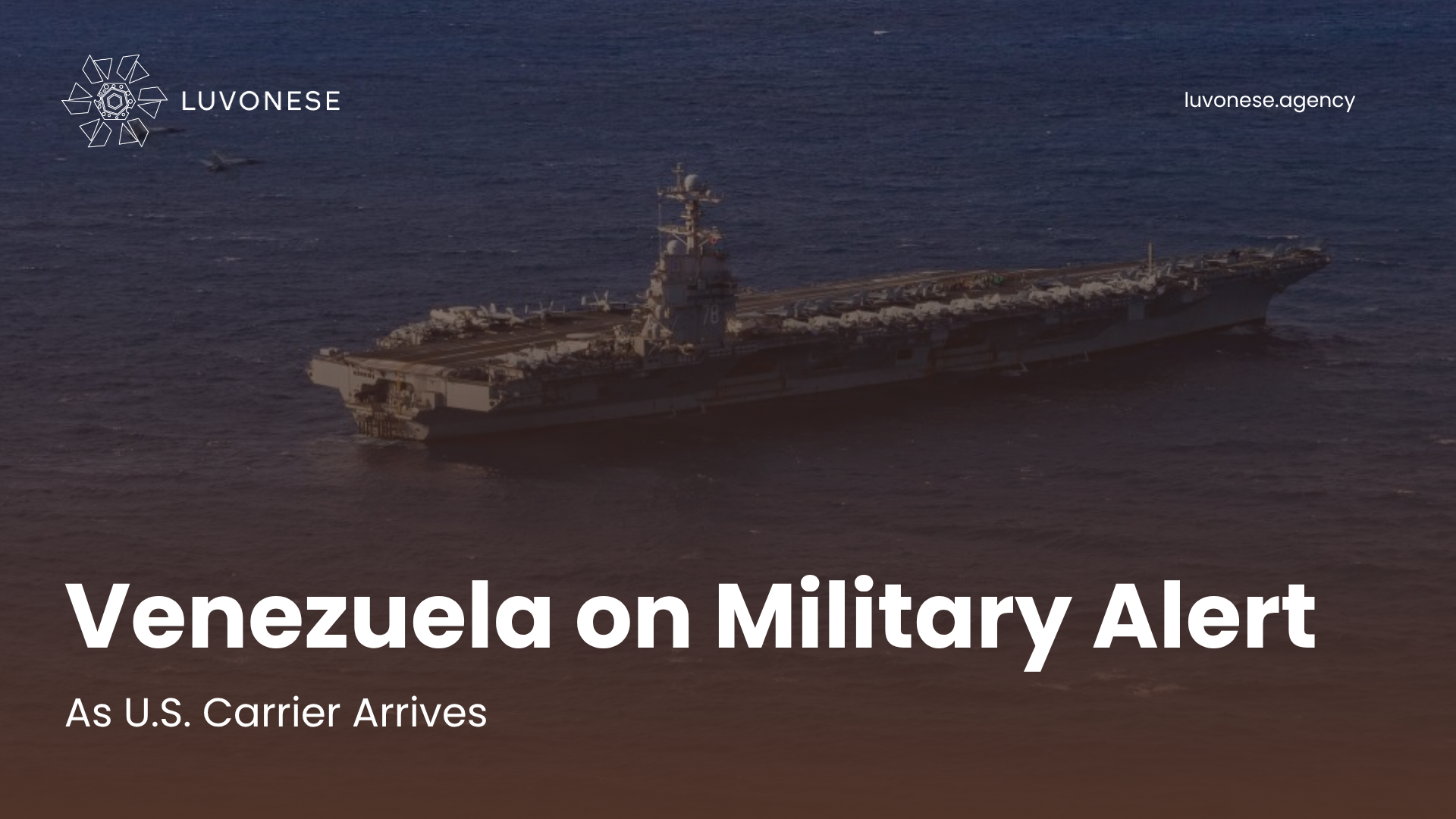
Venezuela has declared a heightened Venezuela military alert after the arrival of the USS Gerald R. Ford carrier strike group in the Caribbean. Government officials ordered all branches of the armed forces to elevate readiness, framing the move as necessary to safeguard national sovereignty. The United States insists the deployment is routine, but the scale of Venezuela’s response has sparked wider regional concern.
A U.S. Carrier Group Sparks Tension
The USS Gerald R. Ford—currently the world’s largest aircraft carrier—arrived as part of a U.S. Southern Command mission. According to Pentagon officials, the deployment supports maritime security, counternarcotics operations, and regional stability.
Venezuelan leaders, however, have portrayed the presence as a direct provocation, citing strained relations and longstanding U.S. sanctions.
Nationwide Military Readiness Order
Defense Minister Vladimir Padrino López announced a sweeping mobilization involving roughly 200,000 personnel. The directive activated air-defense systems, naval units, missile batteries, coastal radar sites, and the Bolivarian militia.
Officials described this posture as a “defensive shield” designed to deter foreign interference without escalating the situation.
Competing Narratives From Caracas and Washington
U.S. officials insist that all operations remain within international waters and follow established maritime procedures. Venezuelan state media claims U.S. aircraft have flown near territorial boundaries—an allegation Washington has not confirmed.
President Nicolás Maduro labeled the mobilization a precaution against “imperialist pressure,” while U.S. officials maintain that the deployment is not aimed at Venezuela specifically.
Historical Parallels and Strategic Messaging
Analysts note that the standoff mirrors earlier moments in Cold War diplomacy, where naval presence often escalated political tensions. Comparisons have been drawn to the Gulf of Tonkin—not because war is expected, but because maritime confrontations can quickly influence national policies.
In Venezuela’s case, the government is leveraging external threats to reinforce internal unity and shift attention away from domestic turmoil.
Regional Reactions and Strategic Stakes
The Venezuela military alert has implications beyond bilateral tensions.
Neighboring countries—Colombia, Guyana, and Brazil—are monitoring developments through regional bodies such as the Organization of American States. Caribbean nations aligned with the U.S. have raised concerns about maritime security, while Venezuela seeks diplomatic support from allies including Cuba and Nicaragua.
The situation highlights ongoing competition among global powers, with China and Russia maintaining economic and military ties to Caracas.
Socio-Political Impact Inside Venezuela
The mobilization serves both strategic and political purposes.
Within Venezuela, it reinforces the narrative that the government remains the protector of national sovereignty, especially during a period marked by economic hardship, inflation, and political fragmentation.
Military visibility has long been a tool used by the Maduro administration to strengthen internal cohesion and project authority.
Potential Risks and the Path Forward
Although neither side appears poised for direct conflict, experts caution that close military posturing increases the risk of miscommunication or unintended escalation. Maritime encounters, airborne patrols, or disputed radar readings could trigger diplomatic fallout if not carefully managed.
For now, the situation remains tense but restrained, with both governments relying heavily on controlled messaging to avoid alarming international partners.
Conclusion: A Volatile Moment With Regional Implications
The arrival of the U.S. carrier strike group and Venezuela’s nationwide military alert have created a delicate geopolitical moment in the Caribbean.
The combination of political signaling, regional alliances, and historical grievances underscores the need for calm diplomacy. Clear communication and restraint will be essential to preventing escalation as both nations navigate this period of heightened tension.